Hacham Sasson Shanduch
Date of Birth: 5507 (1747)Date of Death: 6th of Tevet, 5590 (1830)

Hacham Sasson Shanduch, also known as Hacham Sasson Ajami or the RaSHa"M, was born to Freikha and Mordecai in 1747, in Baghdad. Very little is known about his childhood. In 1762, at the age of 15, he traveled to the Land of Israel with two rabbis who went on a pilgrimage to the high priest Yehoshua ben Yehotzaddok's tomb. Hacham Sasson Shanduch writes that Yehoshua ben Yehotzaddok appeared to him at the tomb and revealed that he, Hacham Sasson Shanduch, was destined to become governor of Baghdad. From that moment to his dying day, he was to witness a series of miraculous events, healings, and acts of deliverance that helped protect the Jews of Baghdad from persecution. Once, during a particularly severe drought in Iraq, he led the public in the Tikun for rain, and as he began to chant the prayer, it began to rain.
Hacham Sasson Shanduch was popular in Baghdad, and admired by non-Jews as well. He was given his nickname, Ajami (Persian), after he healed the son of one of Baghdad's Arab governors and received, in return, a valuable suit made of striped cloth, in the Persian fashion.
In 1812 Hacham Sasson Shanduch was appointed to oversee marriage contracts in Baghdad. In practice, he handled all the rituals that marked the individual's life cycle, from circumcision and marriage to burial. He had an outstandingly beautiful voice and was the cantor at the Great Synagogue in Baghdad; he composed many piyutim, some of which are sung in the Iraqi Jewish communities to this day. Hacham Sasson Shanduch was also a craftsman and renowned for his talent as a manuscript scribe; he could write out verses on grains of wheat. He used his talents to construct models of the Temple and Tabernacle. It was he who designed the parochet (curtain) for the Torah ark in the Great Synagogue that depicted the Temple and the partition of the Land of Israel into the tribal allotments described in the Book of Ezekiel. This parochet was only used once a year, on the Shemini Atzeret festival.
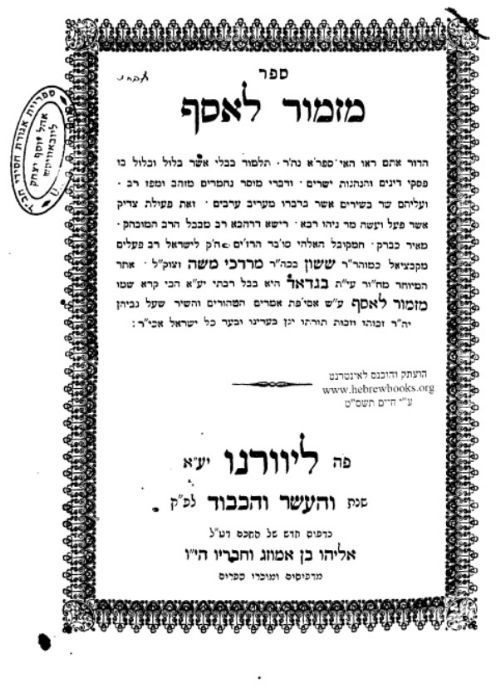
Hacham Sasson Shanduch authored many works, although some of his manuscripts have since been lost. Among those that are accessible, one counts Mizmor LeAssaf – laws on prayer, sermons, and piyuttim, Davar Be'ito – religious laws, sermons, and piyuttim for annual festivals, the Sabbath day and the New Moon, Imrei Sasson – a book on ethics, and Tehilla Le'David – a kabalistic commentary on Psalm 145, sermons and piyuttim.
Hacham Sasson Ajami Shanduch passed away on 6 Tevet, 5590 (1830) and was buried in Baghdad.

